

Metal Gratings: Types, Materials and Load Classes Explained
Metal gratings carry people, forklifts and sometimes aircraft, yet they are often ordered with a single line on a purchase order: "galvanized grating, 30 mm". That line leaves the manufacturer to guess the bar size, mesh, span direction and load rating. This guide explains the main types of metal gratings, how to choose the material, and which specifications you need to send so that the grating you receive is the grating your project needs.
What Are Metal Gratings?
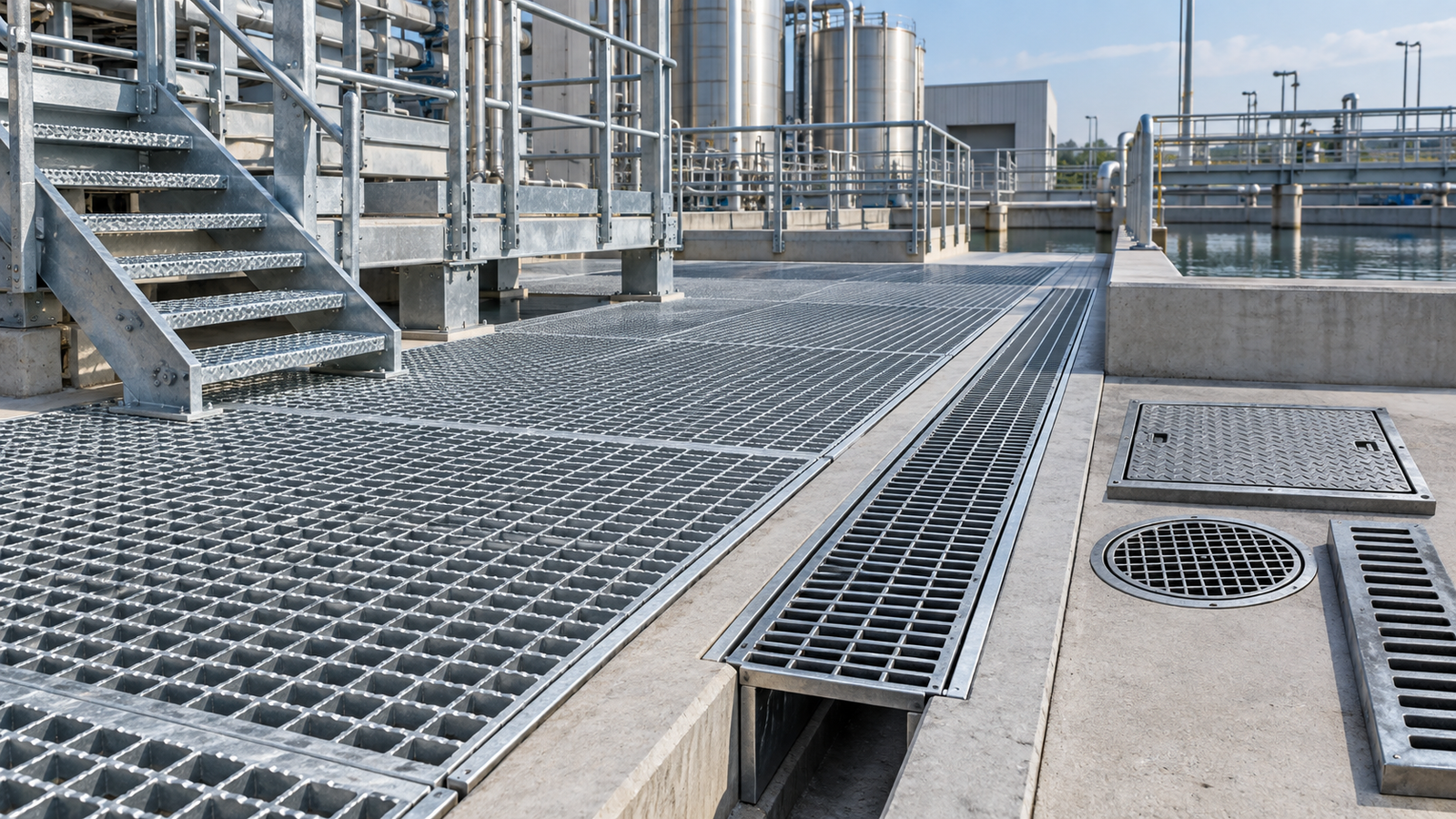
A metal grating is an open grid made of parallel bearing bars (flat bars set on edge that carry the load) held in position by cross bars at right angles. The open area lets water, light, air and debris pass through, while the bearing bars give high strength for a low weight.
In industry, the term covers two product families that are often confused:
- Platform (bar) gratings for walkways, mezzanines, stair treads, catwalks and trench covers. These are designed by span and distributed load. See our steel platform gratings range.
- Drainage gratings and grates that sit on a channel or a gully and are rated by load class under EN 1433 or EN 124. See channel grating systems.
The two families are specified differently, so it helps to know which one you are buying before you ask for a quote.
Welded vs Press-Locked Gratings
The way the cross bars are joined to the bearing bars defines the grating type. It affects strength, appearance and price.
| Type | How it is made | Strengths | Typical use |
|---|---|---|---|
| Welded (electro-forged) | Twisted square cross bars are resistance-welded into the top of the bearing bars under high pressure | Rigid, high load capacity, cost-effective in large volumes | Industrial platforms, walkways, plant flooring, trench covers |
| Press-locked | Cross bars are pressed into slots in the bearing bars, giving a flush top surface | Clean appearance, fine mesh options, good lateral stability | Architectural facades, sun screens, public areas, ceilings |
| Swage-locked | Hollow cross bars are swaged (deformed) into the bearing bars | Light weight, common in aluminium | Aluminium walkways, marine and offshore access |
| Riveted | Bent connecting bars are riveted to straight bearing bars | Good resistance to rolling and impact loads | Ramps, bridges, heavy cart traffic |
Any of these types can be supplied with a serrated (notched) top edge for slip resistance. Serrated gratings are standard on outdoor stairs, ramps, oily process areas and ship decks. Note that serrations reduce the effective bar depth, so load tables for serrated gratings are lower than for plain bars of the same size.
Choosing the Material
Most metal gratings are carbon steel, but the right material depends on the environment more than on the load.
| Material | Advantages | Watch out for | Best for |
|---|---|---|---|
| Hot-dip galvanized carbon steel | High strength, lowest cost per m², long service life outdoors | Zinc layer can be attacked by strong acids and alkalis | General industry, energy, logistics, infrastructure |
| Stainless steel (AISI 304 / 316) | Corrosion-resistant, hygienic, easy to clean | Higher cost; choose 316 for chlorides and coastal sites | Food and beverage, pharma, coastal and pool areas |
| Aluminium | Low weight (about one third of steel), no rust | Lower stiffness, so spans are shorter for the same load | Marine access, removable panels, architectural use |
| FRP / GRP composite | Non-conductive, non-magnetic, chemical-resistant | UV protection and fire rating must be specified | Chemical plants, electrical areas, offshore |
If your site is electrically sensitive or highly corrosive, compare steel with our composite (GRP/FRP) covers and grates before you decide. For the difference between carbon and stainless grades in general, see Carbon Steel vs Stainless Steel: Which Should You Buy?
How to Specify a Steel Platform Grating
A platform grating is sized by its bearing bars and its span. The span is the clear distance between supports, and it always runs in the direction of the bearing bars. Getting the span direction wrong is the most common reason a grating fails inspection on site.

Send the following with every enquiry and you will receive a comparable quote from any manufacturer:
- Bearing bar size (height × thickness), for example 30 × 3 mm or 40 × 3 mm. Taller bars carry longer spans.
- Mesh size (bearing bar pitch × cross bar pitch), for example 34 × 38 mm or 30 × 100 mm. A finer mesh is safer for pedestrians; a wider mesh is lighter and drains better.
- Clear span and span direction, marked on a drawing.
- Design load, as a uniformly distributed load (kN/m²) and a point load (kN), plus any wheel loads from trolleys or forklifts.
- Allowable deflection. A common criterion is span/200, with a maximum of 4 mm for pedestrian areas.
- Panel dimensions, cut-outs and banding (edge bars around openings for pipes and columns).
- Surface: plain or serrated.
- Finish: hot-dip galvanized to EN ISO 1461, painted, stainless or aluminium.
- Fixing method: saddle clips, welding or bolted clamps.
- Applicable standard: for example DIN 24537, RAL-GZ 638 or ANSI/NAAMM MBG 531 for US projects.
Drainage Gratings: Load Classes A15 to F900
Gratings that sit on drainage channels or gullies are not sized by span. They are tested and classified by load class: EN 1433 for drainage channels and EN 124 for gully tops and manhole covers. The class is a structural requirement, not a preference. An under-rated grating in a trafficked area is a safety failure.
| Class | Test load | Typical location |
|---|---|---|
| A15 | 15 kN | Pedestrian areas, cycle paths, roof terraces |
| B125 | 125 kN | Footpaths, car parks, light vehicle access |
| C250 | 250 kN | Kerbside gutters, slow-speed service roads |
| D400 | 400 kN | Roads, car parks, carriageways |
| E600 | 600 kN | Docks, ports, heavy vehicle yards |
| F900 | 900 kN | Airports, aircraft stands, heavy logistics |
Galvanized steel channel gratings usually cover classes A15 to C250. Higher classes call for ductile iron, heavy cast iron or reinforced composite. You can compare options on our drainage channel systems and rainwater grates and manhole covers pages.
Finish and Corrosion Protection
For carbon steel gratings, hot-dip galvanizing after fabrication is the standard. The whole panel, including weld points and cut edges, is dipped in molten zinc, so there are no unprotected areas. EN ISO 1461 sets the minimum coating thickness according to the steel thickness. Ask for the galvanizing certificate with the delivery.
Painting over galvanizing (a duplex system) is useful where colour coding is needed or where the environment is very aggressive. Electro-galvanized or painted-only gratings cost less but are only suitable for dry indoor areas.
Where Metal Gratings Are Used
Industrial plants
Walkways, mezzanines, maintenance platforms and stair treads around machinery and tanks.
Energy and utilities
Power plants, substations and water treatment facilities, often with GRP in electrical zones.
Logistics and ports
Loading ramps, trench covers and heavy-duty drainage gratings in classes D400 to F900.
Construction and urban works
Channel gratings, tree grilles, access covers and stairways in public spaces.
Food and pharma
Stainless gratings and drains that withstand washdown and cleaning chemicals.
Architecture
Press-locked facade panels, sun screens, fences and pool grilles.
Sourcing Metal Gratings from Türkiye
Turkish manufacturers supply welded and press-locked steel gratings, channel gratings and EN 124 / EN 1433 certified drainage products to construction and infrastructure projects across Europe, the Middle East and Africa. For European buyers, short transit times by road and sea and the EU–Türkiye customs union for industrial goods make Türkiye a practical alternative to Far East supply.
Through Steeling.net you can order steel platform gratings, stair treads, channel gratings and drainage systems from certified Turkish producers, cut to your panel sizes and delivered with galvanizing and EN test certificates. Start with our gratings and drainage systems overview, or read How to Source Steel from Turkey for the full procurement process.
Frequently Asked Questions
What is the most common size of steel grating?
For industrial walkways, 30 × 3 mm bearing bars with a 34 × 38 mm mesh, hot-dip galvanized, is the most widely used combination in Europe. It suits spans of up to about 1 metre under normal pedestrian loads. Always check the load table for your exact span.
What is the difference between welded and press-locked gratings?
Welded gratings have twisted cross bars welded into the bearing bars and are the standard choice for industrial floors. Press-locked gratings have cross bars pressed into slots, which gives a flush, uniform surface preferred for architectural use.
Which way should the bearing bars run?
Bearing bars must always run between the supports, in the direction of the span. Cross bars only hold the bearing bars in place and do not carry the main load.
Are galvanized steel gratings suitable for outdoor use?
Yes. Hot-dip galvanized gratings to EN ISO 1461 are designed for outdoor service and typically last for decades in rural and urban atmospheres. In coastal or chemical environments, consider stainless steel or GRP.
What load class do I need for a drainage grating in a car park?
Car parks for passenger vehicles usually need class B125 or C250. Where trucks or service vehicles drive over the grating, specify D400 or higher under EN 1433 or EN 124.
Can I order metal gratings cut to size?
Yes. Gratings are produced in standard panels and then cut, banded and fitted with openings to your drawing. Send a layout drawing with spans and cut-outs to receive an accurate quote.
Platform gratings, stair treads, channel gratings or drainage covers, made to your sizes and load class by certified Turkish manufacturers. Send your drawing and Steeling.net returns a competitive quote with full EN documentation. No fees for buyers.
Get a Free Quote →